Posted by:- Sushant Mishra
03-11-2026
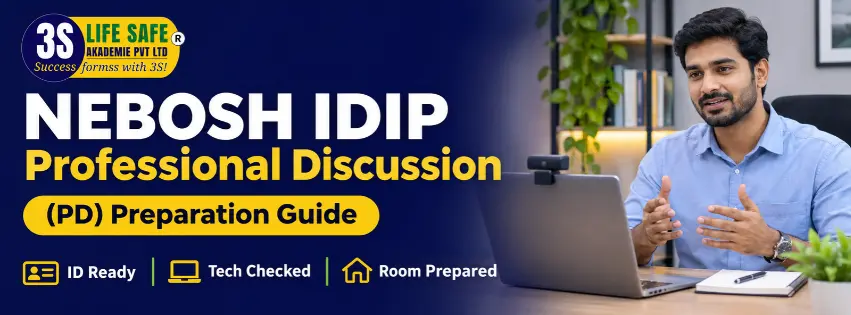
Preparing for your NEBOSH IDIP Professional Discussion (PD) starts with understanding its purpose. After putting substantial effort into your Diploma assessment, you need to be ready to discuss your submission and complete the required identity and room checks.
The preparation checklist highlights three useful priorities: identification, working audio and video, and a suitable private room. Alongside these practical arrangements, you should feel thoroughly familiar with the work you submitted and the reasoning behind your answers.
This guide explains what to organise, how to prepare your space, and how to approach your NEBOSH IDIP PD confidently. Official requirements are linked to NEBOSH sources; the equipment checks and preparation schedule are practical recommendations to help you get organised.
The NEBOSH International Diploma Professional Discussion helps establish that your submitted assessment is your own work. Your interviewer asks about your submission to check its authenticity and ensure compliance with the NEBOSH Malpractice Policy. It is not a separately marked assessment, and you do not receive a pass or refer grade for the discussion.
Your NEBOSH IDip Learning Partner arranges the appointment after the assessment. It can take place by video link or in person, with an interviewer nominated by the Learning Partner. Attendance is compulsory: NEBOSH states that results will not be released if you do not attend. (To understand what happens after grading, see our guide on how to re-evaluate your NEBOSH exam score).
Syllabus Note: For context, the 2023 specification of the NEBOSH Level 6 International Diploma uses units DI1, DI2, and DI3. Older resources may mention ID1, ID2 and ID3, so check that any assessment information you read applies to your specification. Review the full unit breakdown in our NEBOSH International Diploma Syllabus Guide, or compare qualification levels in our NEBOSH IGC vs NEBOSH IDIP comparison.
NEBOSH’s Diploma learner guide lists three identification options: a passport, driving licence, or national identity card. Your interviewer checks your identification against your registration details.
Choose a clear, readable document and check its condition well before your appointment. If your document is expired, damaged, or shows different personal details from your registration, contact your Learning Partner beforehand to confirm what you should provide.
For an online discussion, practise holding the document in front of your camera. Avoid glare from windows or overhead lights, allow the camera to focus, and check whether small text is readable. You may need to adjust the distance rather than hold the document very close to the lens.
Keep your learner number and appointment confirmation available for administrative checks. Follow any specific instructions about displaying your date of birth or showing both sides of your identification.
Although guidance diagrams frequently show a passport first, NEBOSH’s published list does not rank these three documents. Confirm any provider-specific preference with your Learning Partner. If you plan to use an Aadhaar card, ask them to confirm its suitability before the appointment.
A reliable technical setup makes it easier to hear questions and respond clearly. Test the actual device, connection and meeting application you intend to use, ideally from the same room.
Place your light source in front of you where possible. A bright window behind you can make your face appear dark. Close unnecessary applications and pause large downloads to reduce avoidable interruptions.
Be ready to keep your camera and microphone available throughout the discussion, following the interviewer’s directions. If your connection is unreliable, ask your Learning Partner about arrangements before the day. Do not assume that an audio-only call can replace the scheduled session.
For a remote discussion, NEBOSH requires a private room and a check of your surroundings. Its Diploma guide also says that the interviewer must be able to see the room’s door while you are seated.
Choose your position before joining. Put the device on a stable surface, check the background, and make sure you can move the camera without disconnecting cables or dropping equipment.
Prepare for a 360-degree room check. Show the room slowly and clearly when requested, following the interviewer’s instructions about which areas to show. NEBOSH’s published learner guide does not prescribe rotating the camera two or three times as a universal rule.
Clear study notes, books and other reference materials from the discussion area. NEBOSH’s helpdesk explains that the room scan checks for other people and notes or resources that might be consulted.
Tell colleagues or household members when you need privacy. A simple notice outside the door can reduce accidental interruptions. Turn off television audio and silence unnecessary notifications before joining.
Once the practical arrangements are ready, turn your attention to your submission. A useful preparation exercise is to read it at a comfortable pace and recall how you developed your answers.
For each substantial response, ask yourself:
Focus on the connection between your ideas. For example, if you recommended a control measure, recall the circumstances that made it relevant and how you expected it to address the issue. Articulating your rationale reinforces what you mastered throughout your NEBOSH International Diploma course.
Practise explaining a few sections aloud in your own words. Avoid turning your submission into a memorised script: natural explanations make it easier to respond when a question is phrased differently from what you expected.
Complete this review before the appointment. Do not treat preparation notes as materials you can consult during the discussion. Keep your submitted work securely saved for your records; NEBOSH’s technical guide recommends retaining the original submission until results are declared.
The usual sequence in NEBOSH’s Diploma guide is an introduction, an identification check, a room check for video discussions, questions about your assessment, and closure. The interviewer cannot give you the outcome at the end.
Listen to each question fully before answering. If the audio breaks up, explain that you missed part of the question and ask for it to be repeated. This is more useful than responding to something you only partly heard.
Aim to make your explanation easy to follow. You can start with the point you made in your submission, explain why you made it, and then connect it to the relevant circumstances. Avoid adding unrelated material simply to make an answer longer.
If you cannot recall a detail, say so honestly. Do not invent a source, example or explanation. Treat the conversation as an opportunity to describe your actual work clearly.
The following are original self-review prompts to test your readiness—not official NEBOSH questions or predictions of what your interviewer will ask:
Use the prompts to identify sections you need to reread. You do not need to prepare polished speeches for every paragraph. The aim is to reconnect with your own reasoning and become comfortable discussing it.
Avoid relying on supposed guaranteed question banks or ready-made answers. Generic responses cannot explain the particular decisions you made in your submission.
Check your appointment date, time zone, meeting link and contact details. Read the instructions sent by your Learning Partner. Select your identification, test your equipment and choose a room where the camera can show the door. Review your submitted assessment in manageable sections. Leave enough time to resolve administrative or access questions without rushing.
Check the meeting application again, charge your device and arrange the desk. Tell anyone sharing the space when you need privacy. Confirm that your identification is easy to reach and that your camera can show it clearly.
Allow a small time buffer. Check your internet connection, audio and lighting, then clear reference materials from the area. Keep water nearby, silence notifications and settle into your planned seating position.
*Note: These timings are practical preparation suggestions to keep you organised, not a prescribed NEBOSH schedule.
Prepare your identification, test your equipment, arrange a suitable room and revisit the reasoning in your submission. Completing these steps early gives you more space to concentrate on the conversation itself.
If you study with 3S Life Safe Akademie, contact your course coordinator to confirm your appointment and any provider-specific instructions. If you want to know more about the course structure, see our overview of NEBOSH IDIP course duration and fees in India. Use this checklist alongside the latest NEBOSH guidance and your Learning Partner’s directions when preparing for your NEBOSH IDIP Professional Discussion.
Yes. Your Learning Partner arranges it, and failure to attend prevents your results from being released. If you have not received an appointment or need to rearrange one, contact your Learning Partner directly.
Check the time allocated in your appointment instructions. The official sources referenced here do not specify a universal duration, so avoid planning around an assumed number of minutes. Leave enough flexibility for introductory checks and technical adjustments.
Prepare by reviewing your submission beforehand, but clear notes and reference resources away for the session. NEBOSH’s helpdesk guidance says the room check includes checking for resources you might consult. The discussion must also use the language of the assessment.
Tell your Learning Partner early. NEBOSH’s Diploma guide recognises specific exceptions concerning caring responsibilities and another person’s presence for a reasonable adjustment. Reasonable adjustments require NEBOSH approval; discuss your circumstances in advance.
Try to reconnect using the agreed meeting link, then contact your Learning Partner through the details in your invitation. Explain what happened and follow their instructions. Arrange a suitable backup plan beforehand if your location regularly experiences connectivity problems.