Posted by:- Sushant Mishra
14-11-2026
Scaffolding is a temporary structure that provides working platforms and access for people carrying out construction, repair or maintenance work. It supports workers, tools and materials within its designed capacity. You will often see it beside buildings where teams are plastering walls, painting façades or completing repairs.
Understanding scaffolding starts with three questions: what supports the platform, which components keep it stable, and how can workers use it safely? This guide explains the terminology for construction learners, aspiring safety officers and site supervisors.
In construction, scaffolding creates a temporary place to work where ordinary ground-level access is not enough. A scaffold may stand on rigid supports below the platform or hang from an overhead structure, depending on its design.
For example, imagine a team repairing the outside wall of a building. They need access to the wall, room to work and a place for the tools and materials needed for that task. A suitable scaffold provides that working area while incorporating the protection and access arrangements required for the job.
The word “temporary” describes how long the structure is needed. It does not mean it can be improvised. Its configuration, loading and stability still require proper planning.
Scaffolding is one part of the wider subject of working at height. Choosing the right equipment begins with assessing the task and its risks.
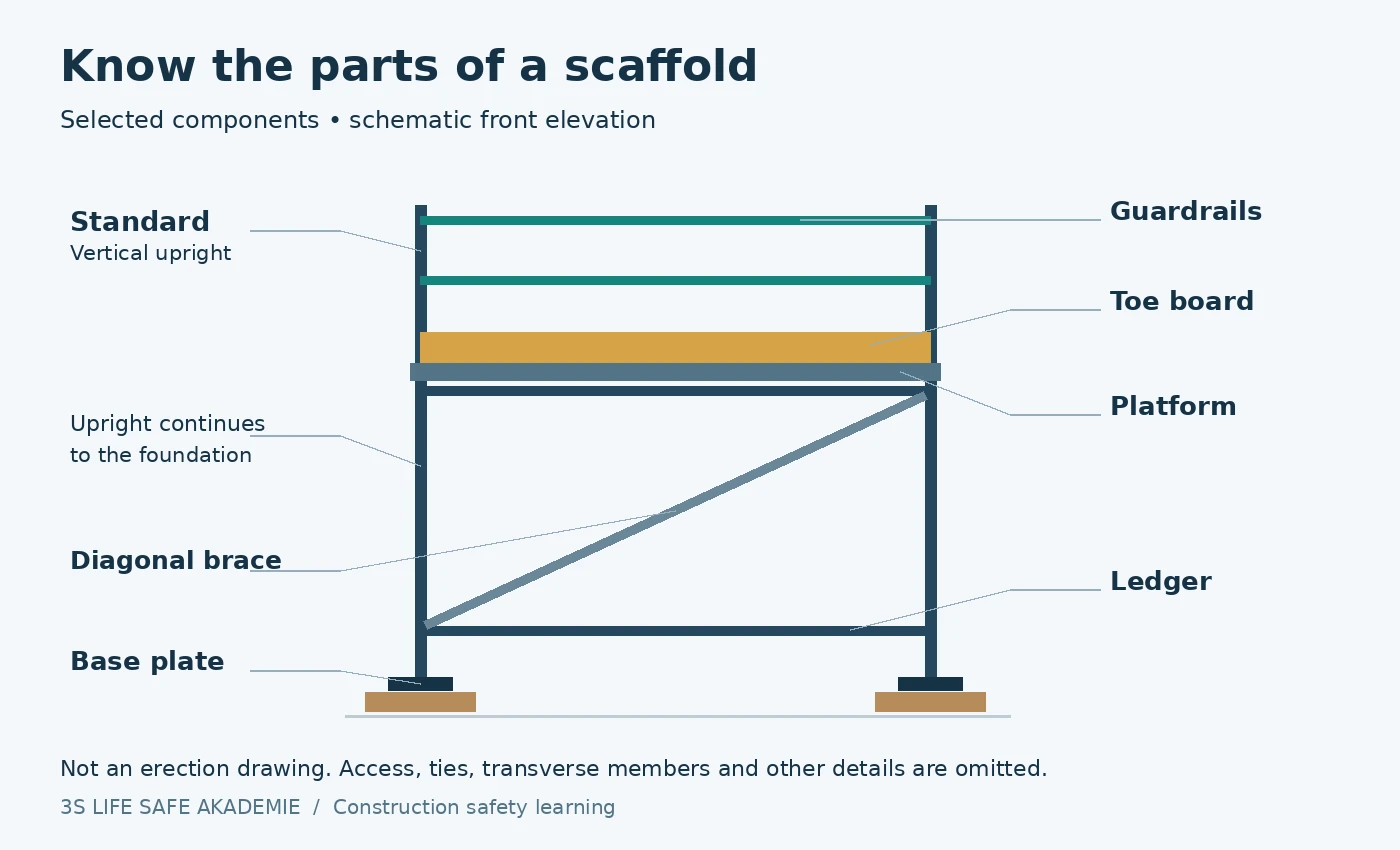
Learning the names of the components makes drawings, training sessions and site discussions easier to follow. The table below describes common parts of a supported access scaffold; the exact arrangement varies by system.
| Component | Main function |
|---|---|
| Standards or uprights | Vertical members that carry loads towards the foundation. |
| Ledgers | Horizontal members running along the length of the scaffold. |
| Transoms or bearers | Members across the width that support platforms and/or connect the scaffold rows, depending on the system. |
| Braces | Diagonal members that help resist distortion and movement. |
| Base plates | Spread the load at the foot of an upright onto its support. |
| Sole boards | Help distribute base loads over suitable supporting ground where required. |
| Platforms or decks | Provide the surface from which people work. |
| Guardrails | Provide edge protection against falls. |
| Toe boards | Help prevent items from being kicked or rolling off platform edges. |
| Ties | Connect the scaffold to a suitable structure for stability where the design requires them. |
| Couplers | Connect tubes in tube-and-coupler scaffolds. |
These terms describe different jobs within the structure. A guardrail is not simply another brace, and a toe board does not replace a guardrail. For terminology and technical background, see the OSHA scaffolding glossary.
A useful starting distinction is supported versus suspended scaffolding. Supported scaffolds transfer loads through rigid supports. Suspended scaffolds hang from an overhead structure using ropes or other non-rigid means.
You will also hear names that describe the connection system, mobility or layout. These categories overlap: a mobile tower, for example, is a supported scaffold.
| Type or configuration | What distinguishes it | Example application |
|---|---|---|
| Tube-and-coupler scaffold | Separate tubes joined by couplers. | Access around complex building shapes. |
| Fabricated frame scaffold | Prefabricated frames supporting platforms. | Building access and maintenance. |
| System scaffold | Purpose-made components with predefined connection points. | Repeated access layouts on construction projects. |
| Mobile tower scaffold | A supported tower fitted with wheels or castors. | Maintenance requiring repositioning between work areas. |
| Suspended scaffold | A platform supported from above; some types can be raised and lowered. | Façade access where the selected system suits the task. |
| Cantilever scaffold | A platform supported by projecting structural members. | Locations where direct support from below is restricted. |
There is no single best type for every project. Selection depends on access, loading, ground or structural support, surroundings and the work itself. The OSHA supported scaffold guide and suspended scaffold guide illustrate the main families.
Scaffolding can provide access for masonry, facade work, painting, repair and maintenance. It can also create working areas around industrial equipment where the task and site conditions justify its use.
Consider two different jobs: repainting a wall and replacing heavy masonry units. Both may need an elevated platform, but their loading and work-area requirements differ. Equipment suitable for one task should not automatically be assumed suitable for the other.
This is why scaffold selection is more than choosing a height. The people planning the work need to understand what workers will do, what they will bring onto the platform and how they will reach it.
These terms are easy to confuse because all three involve temporary works. Their main purposes are different.
| Term | Main purpose | Simple example |
|---|---|---|
| Scaffolding | Provides working platforms and access for people. | A platform beside a wall being repaired. |
| Formwork | Contains and shapes fresh concrete, with its associated support system. | Panels forming the sides of a concrete column. |
| Shoring | Temporarily supports a structure or ground. | Props supporting an existing floor during alterations. |
Formwork can include shores as part of its support system; see the OSHA concrete-work definitions.
Some proprietary components can be used in more than one temporary-works application. That does not make the completed arrangements interchangeable: each needs a design appropriate to its purpose and loads.
For a beginner, remember the purpose first: scaffolding gives access, formwork gives concrete its shape, and shoring provides temporary support.
Understanding the meaning is only the first step. Workers also need to recognise conditions that can make a scaffold unsafe.
| Hazard | Practical prevention principle |
|---|---|
| Falls from platforms | Provide suitable edge protection and safe access; use personal fall protection where the assessment and system require it. |
| Instability or collapse | Follow the design, foundation requirements and specified bracing and ties. |
| Falling objects | Control materials, provide suitable containment and protect people below. |
| Overloading | Keep people, equipment and materials within the permitted loading. |
| Electrical contact | Plan safe separation from power lines and other electrical hazards. |
| Slips and trips | Keep decks clear and address slippery surfaces. |
Scaffolds should be erected, altered and dismantled by competent people under appropriate supervision. Users should not remove ties, braces or protective components to make a task easier. See the HSE scaffold guidance and OSHA general requirements for technical background.
Those sources describe UK and US frameworks respectively. For work in India, confirm applicable requirements, manufacturer instructions and the project’s approved arrangements. This introductory guide is not a scaffold design or a substitute for task-specific training.
Scaffolding is a temporary arrangement of supports and platforms that gives workers access to places where construction or maintenance work is needed.
“A scaffold” commonly refers to one structure. “Scaffolding” is the broader term for the assembled structures or equipment. On construction sites, people sometimes use the terms interchangeably.
Usually, no. It is temporary access equipment, installed for a particular phase of work and removed when it is no longer required. How long it stays in place depends on the project.
No. A ladder and a scaffold are different access equipment. A scaffold provides a working platform; a ladder has rungs or steps. Which equipment is suitable depends on the task and risk assessment.
Use the inspection schedule required by the applicable rules and site arrangements. Inspection is also important after alterations or events that could affect safety. Do not assume an overseas inspection interval automatically applies to an Indian project. The HSE inspection FAQ gives the UK approach.
No. A tag can communicate inspection status, but it does not replace inspection records, competent assessment or attention to changed conditions. Report visible damage or missing components even if a tag is present.
Knowing the components and purpose of scaffolding helps you ask better questions during training and on site. The next step is learning how access equipment fits into hazard identification, risk assessment and safe work planning.
Explore construction safety training at 3S Life Safe Akademie, or view our construction safety course options to discuss learning suited to your role.
Enquire Now